
Create knitted textures on illustrated blankets and cushions
Suggest knitted fabric with small V-shaped marks, regular spacing, and changes in direction. Practice on your own cushion sketch before completing a scene.
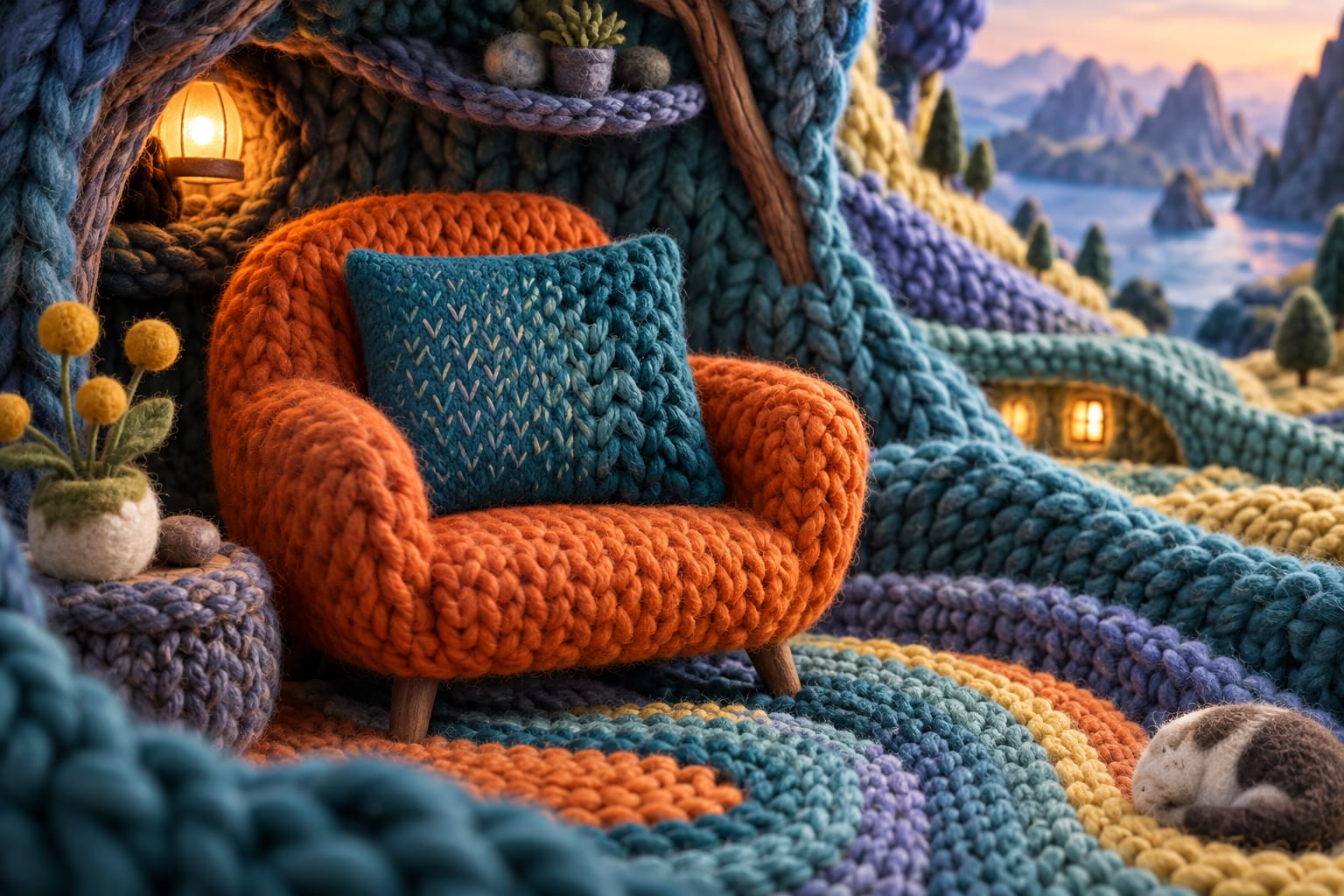
To suggest knitting on an illustrated blanket or cushion, try rows of small V-shaped marks with space between them. Keep a recognizable direction and adjust the route where the fabric folds. You do not need to draw every thread; a few well-placed rows can establish the texture.
Begin with a simple cushion you have drawn yourself on separate paper. This gives you room to choose the scale of the marks before committing to a coloring page. The example is a standalone exercise; it does not assume that a particular Chroma Shu book contains blankets or cushions.
Choose a scale that fits
A large mark may look appealing on a broad cushion and overpower a tiny detail. Draw a short row and view it from your usual reading distance. If you see only separate letter Vs, try making them smaller or lighter. If they merge into a dark patch, increase the spacing.
Getty explains that artists can suggest texture visually through lines and shading. Our exercise uses that idea to create a simplified knitted surface. It is not a knitting pattern or an exact diagram of a textile structure.
Build a small sample
- Establish a base: lightly color the cushion, preserving a slightly lighter area if you want to suggest illumination.
- Make a short row: place small Vs at roughly even intervals. Use enough pressure to distinguish them without overpowering the shape.
- Repeat below: keep a similar scale and direction. Every mark does not have to be identical.
- Leave a pause: end some rows before covering the whole surface. Check whether the fabric already reads clearly.
- Try a fold: curve the route gently and concentrate a few marks in the area you have chosen to shade.
A cushion with one folded corner
Imagine the upper-right corner of a cushion turning inward. Across the front, the rows can follow a nearly vertical path. Near the fold, gradually tilt them to follow the change in surface. Add a short shadow at the join and keep the marks lighter in the illuminated area.
Compare this version with another where every row crosses the fold without changing direction. Choose whichever better describes the shape you want. Comparing two small studies can be more useful than trying to correct every stitch throughout a long coloring session.
Mistakes that change the texture
- Pressing equally hard on every mark and creating a very dark grid.
- Changing the size of the Vs without a connection to the fold or distance.
- Filling every gap until the separate rows disappear.
- Adding texture over a printed pattern so detailed that the two structures compete.
A common question
Do I have to cover the whole blanket with stitches?
No. You can concentrate them near an edge or within the shaded area and keep the rest softer. If you prefer complete coverage, work through small sections and check occasionally that the overall shape remains clear.
Keep your sample for future drawings of interiors or clothing. When you feel like exploring other subjects, visit the Chroma Shu book collection and choose from illustrations you can actually inspect, without assuming a particular object will appear.
Conceptual source: Getty's elements of art: texture. The cushion and rows of marks are an original exercise from Equipo Chroma Shu.

Be the first person to leave a little trace of color here.