
One Landscape, Three Moods: Morning, Sunset or Night
The imagined time of day changes an entire landscape palette: soft morning light, warm sunset contrast or deep night color.
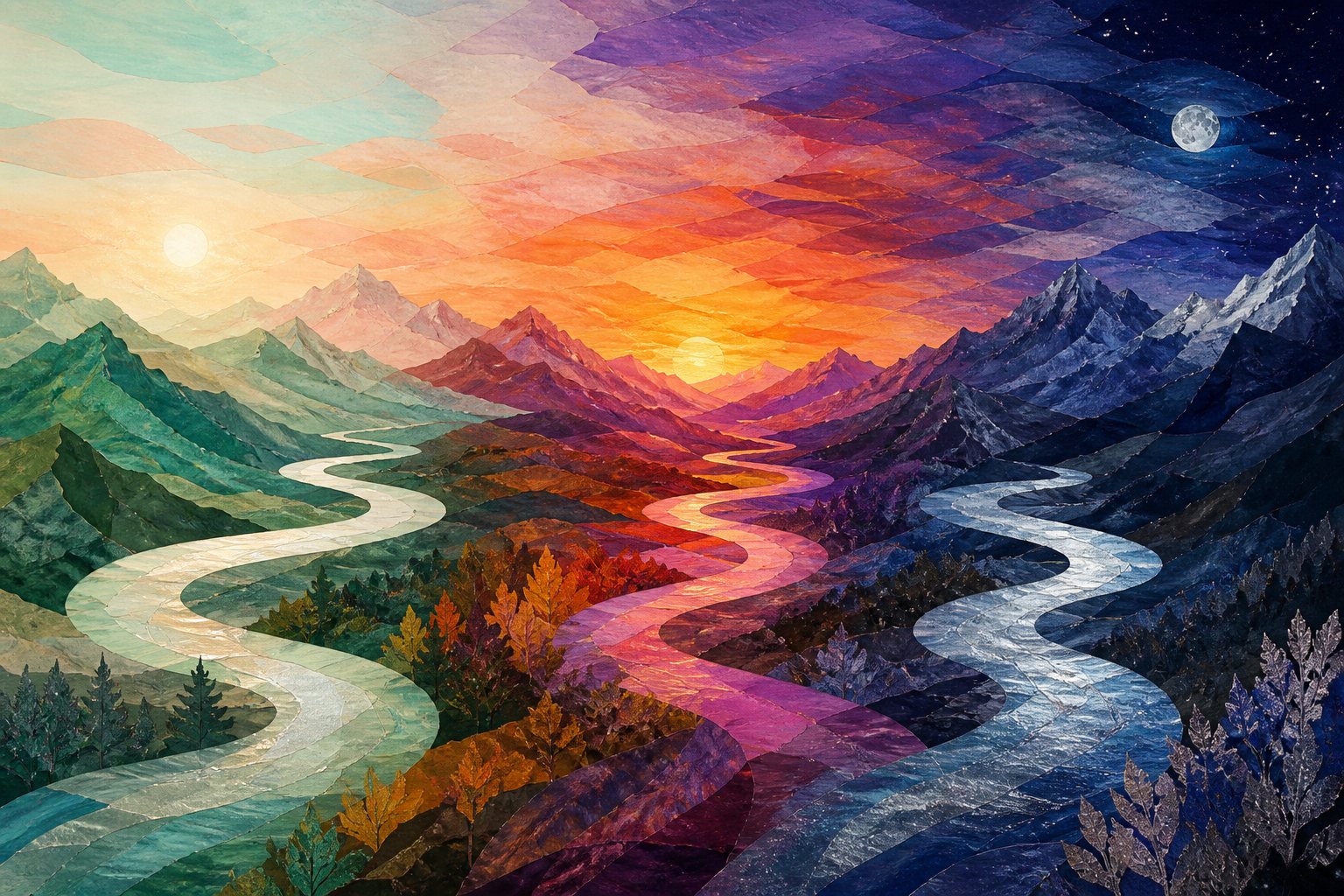
Short answer: The imagined time of day changes an entire landscape palette: soft morning light, warm sunset contrast or deep night color.
Before choosing a color for every tree, rock or cloud, decide what time of day exists inside the scene. That choice gives you a simple rule for connecting sky, ground, water and shadows.
How the atmosphere changes
Morning can use lighter values, fresh greens and blue-leaning shadows. Sunset invites oranges, pinks and violets that echo through the landscape. Night does not have to be black: indigo, deep turquoise and a few luminous accents preserve detail and mystery.
Design the scene before coloring it
- Choose a time of day and write three words for its mood.
- Select one dominant color for the sky.
- Echo that shade lightly in water, paths or shadows.
- Place the strongest contrast near the focal point.
- Save small details for the end.
You can return to a similar illustration later and create an entirely different scene. That is one of the pleasures of landscapes: they hold not only a place, but also a temperature, a light and a moment.
Practical example: the same river at sunset
Begin the sky with peach near the horizon and violet above. Echo both colors more softly in the water, leaving one pale strip for reflected light. Use deep green in the nearest trees and blue-gray in the distant mountains; that temperature shift helps create depth. One small warm yellow note in a window or the sun can become the focal point.
Common atmosphere mistakes
- Coloring every element separately: repeat sky colors in the ground and water to connect the scene.
- Using equal contrast in every plane: soften the distance and strengthen the foreground.
- Turning night into uniform black: preserve cool variations and a few small lights.
Make a three-centimeter thumbnail
Before working on the final page, draw a small rectangle and place only the main masses: sky, land, focal light and shadow. This quick test shows whether the atmosphere works without forcing you to decide every tree and stone.
One final check: cover the sky with a sheet of paper and look at the landscape below it. The chosen time of day should still be visible through the reflected colors and shadows. If it disappears, echo one sky color more clearly in the land or water.
Frequently asked question
Does the sky always need to be lighter than the ground?
No. A night or storm sky may be the darkest area. What matters is keeping enough contrast for the landscape silhouette to remain readable.

Be the first person to leave a little trace of color here.